Tag Archives: african biobank


Public health surveillance has traditionally relied on clinics, hospitals, and laboratories to report cases of disease. But across much of Africa, this system captures only part of the picture. Many people do not seek care, cannot access testing, or are excluded from formal health systems altogether. As a result, outbreaks are often detected late, under-reported, or missed entirely.


A recent report in Nature highlights how wastewater surveillance is changing this reality, using sewage to track disease trends at the community level, even when clinical data is limited.


What is wastewater surveillance?


Wastewater surveillance involves testing sewage for genetic material from pathogens such as viruses and bacteria. When people are infected, traces of these pathogens are shed through bodily waste and end up in wastewater systems. By analysing these samples, scientists can estimate disease circulation across entire communities, without relying on individual testing or hospital visits.


In practical terms, one wastewater sample can represent thousands or even millions of people.


Lessons from South Africa


Researchers in South Africa demonstrated how wastewater monitoring can reveal disease trends that conventional surveillance fails to capture. By comparing viral signals in sewage with reported clinical cases, they found a significant gap between actual infections and officially recorded data.


In several instances, wastewater data showed rising infection levels weeks before clinics recorded an increase in cases. This early signal is especially important in lower-income or underserved areas, where testing rates tend to be lower, and outbreaks are more likely to go unnoticed.


The findings underscore a critical reality: absence of data does not mean absence of disease.


Beyond COVID-19


While wastewater surveillance gained prominence during the COVID-19 pandemic, its applications extend far beyond one virus. Researchers are now detecting genetic material linked to:


  • Measles


  • Mpox


  • Influenza


  • Hepatitis A and E


In some cases, these pathogens were identified in wastewater even when no clinical cases had been officially reported in the area. This positions wastewater surveillance as a powerful early-warning system for emerging and re-emerging diseases.


Why this matters for Africa


Wastewater surveillance offers several advantages that are particularly relevant in African contexts:


  • Equity: It captures health data from entire communities, including people who are not represented in clinical systems.


  • Cost-effectiveness: Monitoring a few sites can be more affordable than mass individual testing.


  • Early detection: Public health authorities can respond sooner, potentially preventing wider outbreaks.


  • Genomic insight: Sequencing wastewater samples allows scientists to track variants and pathogen evolution over time.


For regions facing resource constraints, these benefits can strengthen public health decision-making without placing additional burdens on individuals.


The challenges ahead


Despite its promise, wastewater surveillance is not without limitations. It requires:


  • Laboratory infrastructure and sequencing capacity


  • Skilled personnel for data analysis


  • Sustainable funding and policy support


Encouragingly, continental initiatives, including efforts led by Africa CDC, are working toward integrating wastewater and environmental surveillance into broader disease monitoring systems.


Where MyAfroDNA fits in


At MyAfroDNA, we believe that genomic tools should serve real-world public health needs, especially in underrepresented regions. Wastewater surveillance demonstrates how genomics can move beyond laboratories and clinics to inform population-level health decisions.


As Africa continues to invest in biospecimen science, molecular testing, and genomic research, approaches like wastewater surveillance will be essential for building resilient, inclusive health systems.


Better data leads to better decisions and better outcomes for communities.
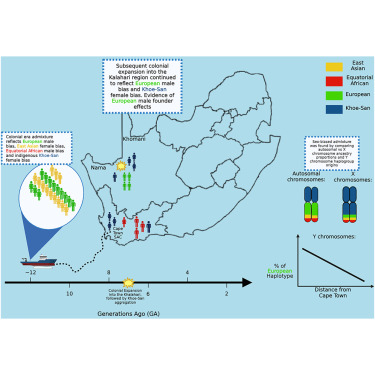


A new study published in The American Journal of Human Genetics reveals how centuries of colonial expansion and the Indian Ocean slave trade shaped South Africa’s genetic landscape, leaving a profound legacy of sex-biased admixture.


Researchers analyzed genetic data from over 1,400 individuals across South Africa to understand how migration and displacement transformed Indigenous communities. The findings show that European male settlers contributed disproportionately to genetic lineages, while Khoe-San women and enslaved women from South and Southeast Asia made major contributions to the maternal gene pool.


Interestingly, while genetic mixing around the Cape was continuous, northern Khoe-San communities experienced a single pulse of European admixture about six to eight generations ago. The Nama people showed unique founder effects, with about 15% of Y-chromosome lineages tracing back to Asia, reflecting the deep genetic impact of forced migrations during colonial times.


This research highlights how genomics can uncover stories of resilience and connection, offering new insight into Africa’s intertwined histories of movement, survival, and identity.


At MyAfroDNA, we are committed to advancing genomics research by providing high-quality African biospecimens and molecular testing services that help decode Africa’s diverse genetic heritage.


Click here for further reading.


In a recent Nature Communications article, Alex M. Vakulskas, Andrew P. Goodman, Paola S. Guerena, William L. Hsieh, Benjamin M. Lane, Joseph N. Blattman, John L. Rinn, and Silvana Konermann present an innovative approach to overcoming one of the biggest challenges in epigenome editing: efficient delivery.


The team developed RENDER (Robust ENveloped Delivery of Epigenome-editor Ribonucleoproteins), a platform that packages CRISPR-based epigenome editors into engineered virus-like particles (eVLPs). Unlike viral vectors or plasmid delivery, which can pose risks of integration and cytotoxicity, RENDER delivers the editors as transient ribonucleoproteins (RNPs), ensuring high specificity and reduced off-target effects.This system was tested across a range of cell types, including iPSC-derived neurons and primary human T cells, showing durable gene silencing from a single treatment.


Remarkably, when applied to neurons carrying the MAPT V337M mutation, RENDER reduced Tau protein expression by more than 60% — a proof-of-concept with implications for treating neurodegenerative diseases.The ability to deliver programmable epigenome editors safely, transiently, and effectively represents a leap forward for gene regulation therapies. With continued optimization, this platform could accelerate progress in epigenetic drug development and broaden research applications. Click here for further reading.


At MyAfroDNA, we understand the importance of access to quality African biospecimens and molecular testing for advancing biomedical innovations like these. Partner with us to power your next research breakthrough.


A new study published by our partners, the AfricaBP Open Institute, showcases transformative efforts to harness biodiversity genomics and bioinformatics to drive a sustainable African bioeconomy.


The Africa BioGenome Project (AfricaBP) aims to sequence 105,000 non‑human genomes across Africa, spanning plants, animals, fungi, and protozoa, to support food security, conservation, and biotech innovation. To bridge capacity gaps, the AfricaBP Open Institute organized 31 hands‑on regional workshops in 2024 across five geographic regions, engaging participants from over 50 African countries. These sessions trained 401 African researchers in genome sequencing, gene editing, bioinformatics, molecular biology, ethics, and biobanking, strengthening local research infrastructure and skills.


A highlight case study: the proposed “1000 Moroccan Genome Project,” which illustrates economic returns from local genome sequencing. Analysis shows that a US$20 million investment over 10 years could yield US$40 million in discounted benefits and deliver a benefit–cost ratio (BCR) of 3.29—meaning every dollar invested returns more than three dollars in value—particularly across agriculture, R&D, education, and downstream sectors.


Key recommendations emerge: integrate biodiversity genomics and bioinformatics into national bioeconomy strategies, expand capacity‑building initiatives, build regional sequencing hubs, and foster ethical, inclusive data-sharing policies. Strategic investment in these domains positions African nations to capitalize on their unique biodiversity and reclaim ownership of genomic science—a powerful lever toward sustainable development and regional innovation rooted in African knowledge and priorities  .


In short, AfricaBP’s model provides a scalable path for leveraging genomic science to fuel a resilient, inclusive African bioeconomy driven by regional talent and locally generated data. Read more here.


A landmark discovery, scientists have sequenced the genome of a man buried around 4,500–4,800 years ago at Nuwayrat in Middle Egypt, marking the oldest complete genome ever recovered from the region. Likely a potter in his 60s, the man was buried in a sealed ceramic jar carved into rock, a burial that helped preserve his DNA despite Egypt’s harsh climate.


This genome confirms ancient people-to-people contact between Egypt and Mesopotamia, echoing archaeological evidence of shared pottery styles and writing systems. The Nile likely served not just as a trade route for goods and ideas, but for human migration too.


The discovery demonstrates that DNA preservation is possible and important to build a clearer understanding of Africa's genetic history.


Learn more about this research here: https://www.nature.com/articles/d41586-025-02102-y


For the first time, researchers have detected the invasive Anopheles stephensi mosquito in Gayi, a rural area in southern Niger Republic — a country already grappling with one of the world’s highest malaria mortality rates.
Genetic analysis confirmed its presence alongside native malaria vectors such as An. gambiae s.s., An. coluzzii, and An. arabiensis. The coexistence of these species has resulted in elevated biting and transmission rates, aligning with the surge in malaria cases reported in 2024.


Experts warn that without immediate investment in robust surveillance, targeted vector control, and regional collaboration, An. stephensi could spread rapidly across the Sahel and beyond. Its presence poses a serious threat to malaria control efforts, especially in vulnerable regions bordering Niger. Urgent action is needed to contain its spread and mitigate its public health impact across Africa.


Learn more: https://www.nature.com/articles/s41598-025-07389-5


After years of stalled progress, the fight against antibiotic resistance is gaining momentum. Scientists are now exploring new ways to treat infections without relying solely on traditional antibiotics, a major shift that could reshape how we manage bacterial diseases worldwide.


Thanks to support from organizations like CARB-X and GARDP, researchers are pushing forward alternatives that were once considered too risky or radical. These include therapies like bacteriophages (viruses that infect bacteria), enzymes called lysins that break down bacterial walls, and even treatments that adjust the body’s natural microbiome.


Some scientists are testing immune-based approaches and CRISPR technology to target bacteria more precisely. These ideas are still early in development, but the growing investment and interest show a renewed belief that we don’t have to stay trapped in the old cycle of resistance.
The hope is that these innovative treatments, along with better diagnostic tools and smarter trial designs, could one day offer safer, more sustainable ways to fight deadly infections, especially as antibiotic resistance continues to rise.


This shift marks a new chapter in global health, where innovation may finally help turn the tide against superbugs.
Learn more here.


New research from the University of Surrey and the University of Oxford has uncovered a reversible mechanism in TB bacteria that may explain why the disease is so hard to treat.


The study shows that Mycobacterium tuberculosis uses a process called ADP-ribosylation to tag its DNA, allowing it to pause or resume growth—a possible survival tactic against antibiotics and immune attacks. The enzymes DarT and DarG act like a molecular switch: DarT adds the tag and halts replication, while DarG removes it to restart bacterial growth.


This discovery marks the first time DNA modification has been shown to control gene expression and replication in any organism.


By manipulating this system using CRISPRi and ADPr-Seq, scientists were able to track how these tags affect gene activity and cell division, offering a new target for drug development, especially against dormant or slow-growing TB cells. With over 1.25 million deaths annually, breakthroughs like this could reshape how we treat one of the world’s deadliest infectious diseases. Learn more here.


The Moroccan Genome Project (MGP) sequenced 109 Moroccan genomes, uncovering over 27 million genetic variants, including 1.4 million new ones. This research introduces the Moroccan Major Allele Reference Genome (MMARG), providing a more accurate representation of Moroccan genetic diversity compared to global references.


By identifying unique genetic variants, MGP aims to improve precision medicine, addressing healthcare disparities for Moroccans and North Africans, especially in diseases like kidney disease, heart conditions, and diabetes.


This initiative builds on Morocco's rich genetic history and aims to create a more comprehensive genomic reference for North Africa, paving the way for better healthcare and research in the region.


Learn more here


A new landmark genetic study has uncovered important insights into breast cancer risk among South African women. The research, led by a collaborative team of scientists and published in Nature, used genome-wide association analysis (GWAS) to explore genetic variants linked to breast cancer in this historically underrepresented population.


By analyzing over 3,500 participants (including 2,485 breast cancer cases), the study identified two significant risk loci—one between the UNC13C and RAB27A genes on chromosome 15, and another within the USP22 gene on chromosome 17. These findings mark the first time these regions have been linked to breast cancer in African populations.


Interestingly, the study also found that polygenic risk scores (PRS) developed from European ancestry datasets poorly predicted risk in this group—explaining less than 1% of the variance. This underlines a growing call in the genomics community: the need for African-specific data to create more accurate and equitable tools for disease prediction and prevention.


Ultimately, this research reinforces the importance of diversity in genomic studies and highlights how African biobanks and community-centered research can reshape global health outcomes.


Want to dive deeper into this research?
Read the full article here:
https://www.nature.com/articles/s41467-025-58789-0