Tag Archives: myafrodna


A new study published in Nature projects that climate change, especially extreme weather events could lead to a substantial increase in malaria cases and deaths across Africa over the next 25 years.


Using 25 years of climate, health, socioeconomic, and disease control data, researchers estimate that climate change could contribute to up to 123 million additional malaria cases and more than 500,000 additional deaths between 2024 and 2050 if current control strategies remain unchanged.


While many studies have focused on how temperature and rainfall affect mosquito ecology, this research shows that extreme weather such as floods and cyclones — will be the main driver of increased risk, disrupting housing, health services, prevention programs, and access to treatment. These disruptions may account for the majority of additional cases and deaths in the coming decades.


Most of the projected increases will occur in regions where malaria is already endemic rather than in entirely new areas, underscoring the vulnerability of existing control systems to climate shocks. These findings highlight a profound challenge: climate change doesn’t just reshape environments, it can undermine disease control infrastructures, particularly where health systems are already fragile.


For genomic scientists and public health researchers, this study reinforces the urgency of climate-resilient malaria strategies that integrate environmental forecasting, vector surveillance, health system preparedness, and genomic research to track parasite and vector evolution under changing conditions.


At MyAfroDNA, we are committed to supporting collaborative research that advances:Climate-informed malaria surveillance Integrated vector genomics and environmental data systemsCommunity-embedded biospecimen collection and analysisData-driven intervention and control strategiesIf you are a researcher, institution, or organization working on malaria, climate health, genomics, or vector-borne disease research, we invite you to partner with MyAfroDNA. Together, we can develop solutions that are tailored to Africa’s climate and health needs.
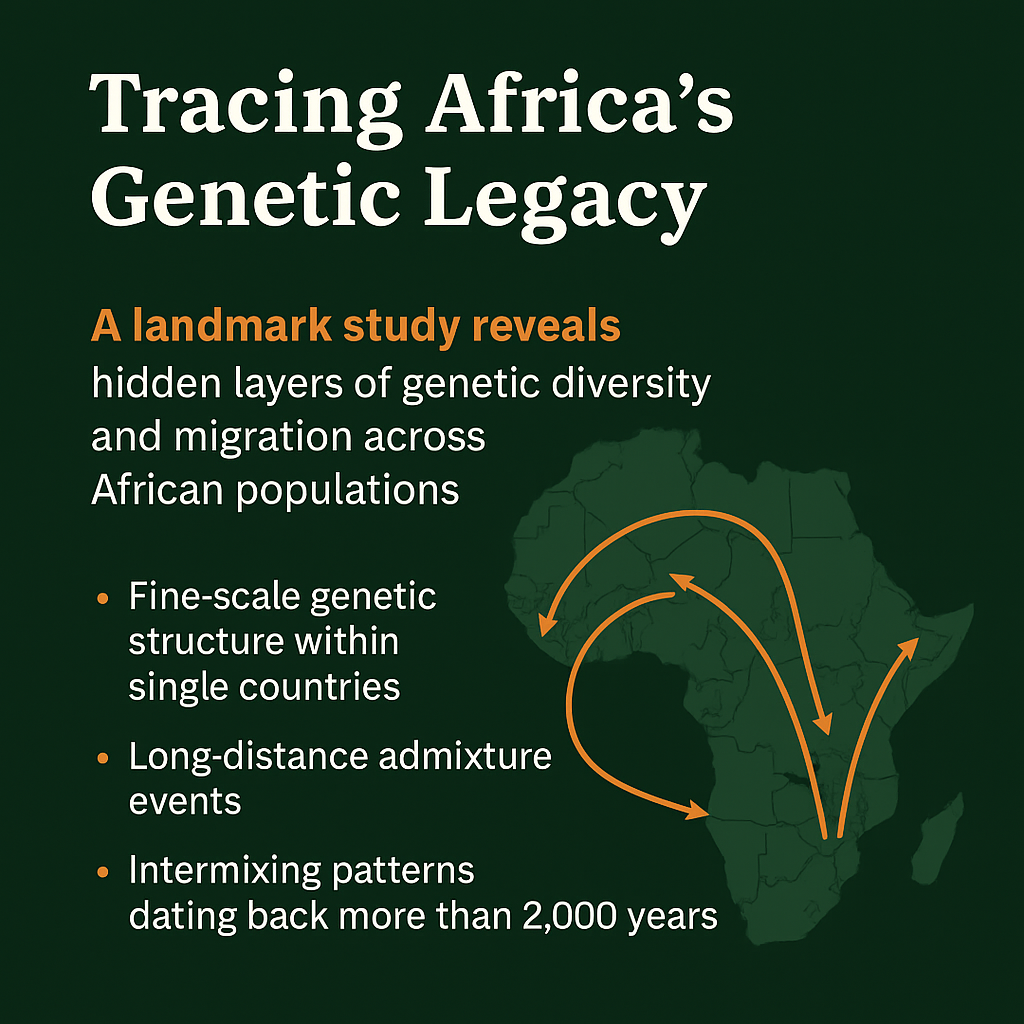
A landmark study led by researchers from University College London (UCL) and published in Science Advances reveals a previously hidden depth of genetic diversity, migration, and admixture within African populations. Titled “Dense sampling of ethnic groups within African countries reveals fine-scale genetic structure and extensive historical admixture,” the research analysed 1,333 genomes from over 150 ethnic groups across Cameroon, Ghana, Nigeria, Sudan, and the Republic of the Congo.


The findings challenge the often simplistic narratives about African genetic history. The study uncovered fine-scale genetic structure within single countries, showing that even neighbouring ethnic groups may carry distinct ancestral lineages. For instance, western Cameroonian groups exhibit unique ancestry signatures reflecting the region’s long history of local kingdoms and cultural interactions.


Researchers also traced long-distance admixture events, linking populations in northern Cameroon and Sudan with distant groups, suggesting centuries of movement through trade, migration, and empire expansion. In Ghana and Nigeria, they detected intermixing patterns dating back more than 2,000 years, likely connected to shifts in climate and vegetation that encouraged population mobility and contact.


Beyond uncovering these complex patterns, the study highlights an essential truth: Africa’s genomic diversity cannot be fully understood through limited or external data. It underscores the urgency of expanding and diversifying African genomic datasets to ensure equitable representation in global genetics research.


For MyAfroDNA, this research reaffirms our mission to strengthen African-centric molecular testing and biospecimen sourcing for both research and precision medicine. Understanding these fine-scale patterns helps scientists interpret genetic variation more accurately, improving ancestry insights and health-related findings for African communities.


As Africa continues to shape the global genomic landscape, studies like this remind us that every region, community, and ancestry carries its own genetic legacy, one that deserves to be studied, respected, and represented on its own terms.


Read the full research here.


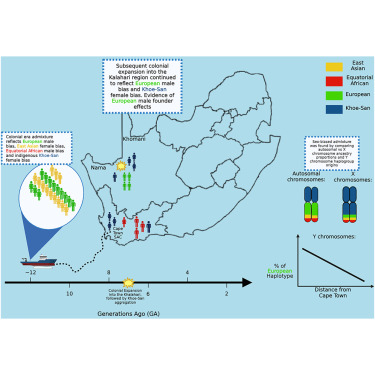
A new study published in The American Journal of Human Genetics reveals how centuries of colonial expansion and the Indian Ocean slave trade shaped South Africa’s genetic landscape, leaving a profound legacy of sex-biased admixture.


Researchers analyzed genetic data from over 1,400 individuals across South Africa to understand how migration and displacement transformed Indigenous communities. The findings show that European male settlers contributed disproportionately to genetic lineages, while Khoe-San women and enslaved women from South and Southeast Asia made major contributions to the maternal gene pool.


Interestingly, while genetic mixing around the Cape was continuous, northern Khoe-San communities experienced a single pulse of European admixture about six to eight generations ago. The Nama people showed unique founder effects, with about 15% of Y-chromosome lineages tracing back to Asia, reflecting the deep genetic impact of forced migrations during colonial times.


This research highlights how genomics can uncover stories of resilience and connection, offering new insight into Africa’s intertwined histories of movement, survival, and identity.


At MyAfroDNA, we are committed to advancing genomics research by providing high-quality African biospecimens and molecular testing services that help decode Africa’s diverse genetic heritage.


Click here for further reading.


A groundbreaking study published in Nature Communications has revealed novel genetic variants associated with carotid intima-media thickness (cIMT), a key marker of early atherosclerosis, among nearly 8,000 adults from sub-Saharan Africa. The research, part of the AWI-Gen project, included participants from Burkina Faso, Ghana, Kenya, and South Africa and marks one of the largest genome-wide association studies (GWAS) on cardiovascular risk in African populations.


Two previously unidentified loci, SIRPA and FBXL17, were found to be significantly associated with cIMT, offering new insight into biological pathways involved in vascular health. Notably, the study also identified sex-specific genetic signals: SNX29 in men, and LARP6 and PROK1 in women, the latter two being enriched for estrogen response genes. These findings suggest different genetic mechanisms for cardiovascular risk between men and women.


Many of the variants identified in this African cohort are either rare or absent in European populations, emphasizing the critical need for diversity in genomic research. This study not only deepens our understanding of cardiovascular disease in African communities but also underscores the importance of building inclusive datasets to drive precision medicine. At MyAfroDNA, we champion this kind of Africa-led genomic science.


Read more on this research here: https://www.nature.com/articles/s41467-022-28276-x


A groundbreaking pair of studies published in Antiquity reveals compelling genetic evidence of West African ancestry in two individuals buried in seventh-century England. The first “West African ancestry in seventh-century England: two individuals from Kent and Dorset” was led by Professor Duncan Sayer of the University of Central Lancashire, examining the female burial from Updown, Kent.


The second, focusing on the male burial at Worth Matravers, Dorset, titled Ancient genomes reveal cosmopolitan ancestry and maternal kinship patterns at post-Roman Worth Matravers, Dorset, was led by Dr. Ceiridwen J. Edwards from the University of Huddersfield.


In both cases, mitochondrial DNA traced maternal lineage to Northern Europe, while autosomal DNA showed clear affinity with present-day Yoruba, Mende, Mandenka, and Esan groups, indicating a West African paternal grandparent.

The Updown burial included a Frankish pot and spoon suggestive of Christian or Byzantine connections, highlighting continental ties, whereas the Dorset individual was interred with local artifacts and a burial companion, underscoring full local integration.


These discoveries represent the first genetic proof of sub-Saharan African connections in Early Medieval Britain, reshaping our understanding of migration, identity, and social complexity in that era.


Read more about this discovery here.


Location: Port Harcourt, Nigeria (Hybrid)
Organization: MyAfroDNA – Advancing African Genomics and Molecular Research
Type: Full-time | Contract | Onsite


About Us


MyAfroDNA is a pioneering biotech dedicated to providing African biospecimens, molecular testing, and CRO services to support global research, public health, and innovation. From paternity testing to biospecimen analysis, we are committed to delivering high-quality scientific services.


Role Overview


We are looking for a dynamic Field Application Scientist to serve as a liason between our laboratory team and external stakeholders. This role is ideal for someone passionate about genomics, diagnostics, and community-focused science, with a talent for building relationships, developing partnerships, and driving client engagement.


Key Responsibilities


  • Promote MyAfroDNA’s services to research institutions, hospitals, NGOs, and private clients.


  • Identify and develop partnerships with universities, labs, and health organizations.


  • Conduct field visits to introduce our services and collect feedback.


  • Represent MyAfroDNA at events, conferences, and local exhibitions.


  • Collaborate with the product team to ensure client needs inform service development.


  • Provide input on marketing strategy from a scientific and community-focused lens.


Requirements


  • Background in Biology, Biotechnology, Public Health, or a related field.


  • Strong communication, networking, and presentation skills.


  • Familiarity with molecular testing and biospecimen collection.


  • Experience working with communities, NGOs, or research teams is a plus.


  • Willingness to travel within Nigeria and beyond as needed.


Bonus Skills


  • Community Engagement


  • Experience with grant writing or science communication


  • Previous work in a startup or research outreach


How to Apply


Please complete the application form using this link and upload your CV and cover letter.


A landmark discovery, scientists have sequenced the genome of a man buried around 4,500–4,800 years ago at Nuwayrat in Middle Egypt, marking the oldest complete genome ever recovered from the region. Likely a potter in his 60s, the man was buried in a sealed ceramic jar carved into rock, a burial that helped preserve his DNA despite Egypt’s harsh climate.


This genome confirms ancient people-to-people contact between Egypt and Mesopotamia, echoing archaeological evidence of shared pottery styles and writing systems. The Nile likely served not just as a trade route for goods and ideas, but for human migration too.


The discovery demonstrates that DNA preservation is possible and important to build a clearer understanding of Africa's genetic history.


Learn more about this research here: https://www.nature.com/articles/d41586-025-02102-y


For the first time, researchers have detected the invasive Anopheles stephensi mosquito in Gayi, a rural area in southern Niger Republic — a country already grappling with one of the world’s highest malaria mortality rates.
Genetic analysis confirmed its presence alongside native malaria vectors such as An. gambiae s.s., An. coluzzii, and An. arabiensis. The coexistence of these species has resulted in elevated biting and transmission rates, aligning with the surge in malaria cases reported in 2024.


Experts warn that without immediate investment in robust surveillance, targeted vector control, and regional collaboration, An. stephensi could spread rapidly across the Sahel and beyond. Its presence poses a serious threat to malaria control efforts, especially in vulnerable regions bordering Niger. Urgent action is needed to contain its spread and mitigate its public health impact across Africa.


Learn more: https://www.nature.com/articles/s41598-025-07389-5


Yale researchers have developed an advanced CRISPR-Cas9 gene-editing system that enables simultaneous modifications across multiple genes, a breakthrough that could transform disease research and treatment development.


Unlike traditional CRISPR methods, which target single genes at a time, this new approach allows scientists to study complex genetic interactions in diseases such as cancer, autoimmune disorders, and neurological conditions.


Using sophisticated mouse models, the research team demonstrated how this enhanced CRISPR system could map genetic pathways and identify potential therapeutic targets more effectively. The ability to edit multiple genes at once provides a deeper understanding of how different mutations contribute to disease, paving the way for more precise gene-based treatments. This advancement is expected to accelerate the development of personalized medicine and improve therapies for conditions with complex genetic underpinnings.


Funded by the National Institutes of Health and the U.S. Department of Defense, this research represents a significant leap forward in biotechnology. By expanding the capabilities of CRISPR, Yale scientists have created a tool that could revolutionize genetic research, offering hope for new treatments in fields ranging from oncology to regenerative medicine.


Learn more about this research: https://www.sciencedaily.com/releases/2025/03/250320145239.htm


A new study led by researchers at Uppsala University has shed light on the deep genetic history of the Fulani people, one of Africa’s largest nomadic pastoralist populations. With over 40 million individuals spread across the Sahel and West Africa, the Fulani have long fascinated historians, linguists, and geneticists. Yet, their ancestry remained largely underrepresented in genomic research until now.


Drawing on data from more than 460 participants across seven African countries, the study reveals that the Fulani's genetic profile is a unique mosaic shaped by ancient migrations and centuries of intermingling with neighboring populations. All Fulani groups studied share a common ancestry linked to the Green Sahara period (12,000–5,000 years ago), a time when now-arid regions of Africa were lush and fertile, supporting early human settlement and pastoralism.


What’s particularly compelling is how the Fulani have preserved a shared genetic signature across vast distances, despite cultural and geographic differences. These findings don’t just contribute to our understanding of African history, they also underscore the importance of including more African populations in genomic research, which has implications for medical science, anthropology, and the global understanding of human diversity.


You can read the full article on Science Daily here: https://www.sciencedaily.com/releases/2025/02/250211134303.htm