

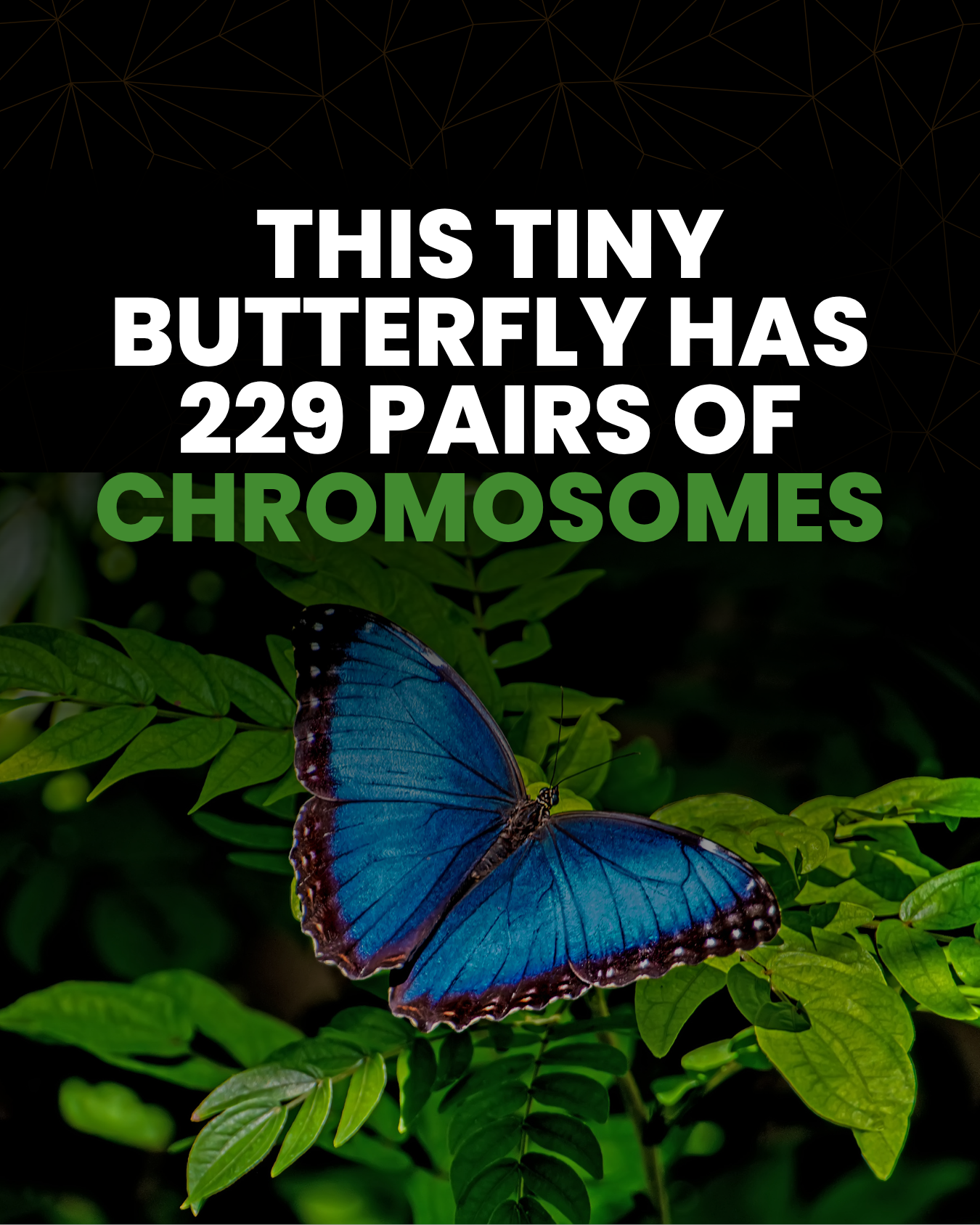
A tiny butterfly from North Africa is helping scientists understand just how dramatically a genome can change.
When we think about chromosomes, humans usually come to mind: 23 pairs of chromosomes in each typical human cell. But the Atlas blue butterfly (Polyommatus atlantica) operates on a very different genomic scale.
Researchers from the Wellcome Sanger Institute and the Institute of Evolutionary Biology (IBE-CSIC-UPF) have confirmed that this elusive butterfly has 229 pairs of chromosomes, the highest chromosome number recorded in a non-polyploid multicellular animal. The discovery was made possible through the first chromosome-level genome sequencing of the species and was published in Current Biology in 2025.
A butterfly with an extraordinary genome
The Atlas blue butterfly is found in the mountain ranges of Morocco and northeastern Algeria. Although scientists had suspected that the species possessed an unusually high chromosome count, genomic sequencing provided the evidence needed to confirm it.
Its closest relatives typically have around 23 or 24 chromosome pairs. So how did this small butterfly end up with 229?
The answer appears to be chromosome fission.
Rather than duplicating its entire genome, the butterfly's ancestral chromosomes were progressively broken into smaller chromosomes. Researchers estimate that the number increased from around 24 ancestral autosomes to the current 227 pairs of autosomes over approximately three million years. The species also has four sex chromosomes.
Interestingly, the chromosome breaks occurred predominantly in regions where DNA is more loosely packed. The researchers also found internal telomeric sequences that may provide clues about how these chromosome breaks occurred and remained viable through evolution.
More chromosomes don't mean a more complex organism
This discovery offers an important reminder: chromosome number does not determine how complex an organism is.
Humans have 23 chromosome pairs. The Atlas blue butterfly has 229. Yet that doesn't make the butterfly “more advanced” genetically.
What matters is how genetic information is organised, regulated and expressed.
This is one reason genome sequencing is so powerful. Researchers aren't simply counting chromosomes. By producing a chromosome-level reference genome, they can investigate how DNA is structured and how that structure has changed over evolutionary time.
What does this have to do with cancer research?
There is an interesting, but still developing, connection.
Chromosome rearrangements are also observed in human cancer cells, where changes to chromosome structure can contribute to genomic instability. The researchers behind the butterfly study have suggested that understanding how extensive chromosome rearrangement can occur while remaining viable could potentially contribute to future cancer research.
However, this does not mean the butterfly has provided a cancer treatment or that its genome directly translates into a new therapy. The immediate significance of the research is in understanding chromosome evolution and genome organisation.
Why genomic sequencing matters for Africa
Perhaps the most important lesson is broader than butterflies.
Every species carries a genomic history. Sequencing allows scientists to investigate that history in unprecedented detail, from evolution and adaptation to disease, conservation and biological diversity.
This is particularly important for Africa.
Africa contains the greatest human genetic diversity in the world, yet African populations remain underrepresented in many global genomic datasets. Building better genomic resources therefore requires more African samples, more sequencing and more research that reflects the continent's diversity.
The Atlas blue butterfly study demonstrates what becomes possible when scientists invest in sequencing organisms whose genomes have previously been poorly understood.
At MyAfroDNA, we believe the same principle applies to African genomic diversity.
The more African genomes we study, the more we can understand the genetic variation, histories and biological diversity that make the continent so important to genomics.
The bigger picture
The Atlas blue butterfly may be tiny, but its genome is giving scientists a much bigger question to explore:
How much can a genome change while an organism continues to survive and evolve?
From chromosome rearrangements in butterflies to genetic diversity across African populations, genome sequencing is helping us answer questions that were once impossible to investigate.
And that is the power of genomics: DNA doesn't just tell us what an organism is. It can tell us where it came from, how it changed and, potentially, where it is going.
Source
Wright, C. J. et al. (2025). Constraints on chromosome evolution revealed by the 229 chromosome pairs of the Atlas blue butterfly. Current Biology, 35, 4727–4742.e7.